

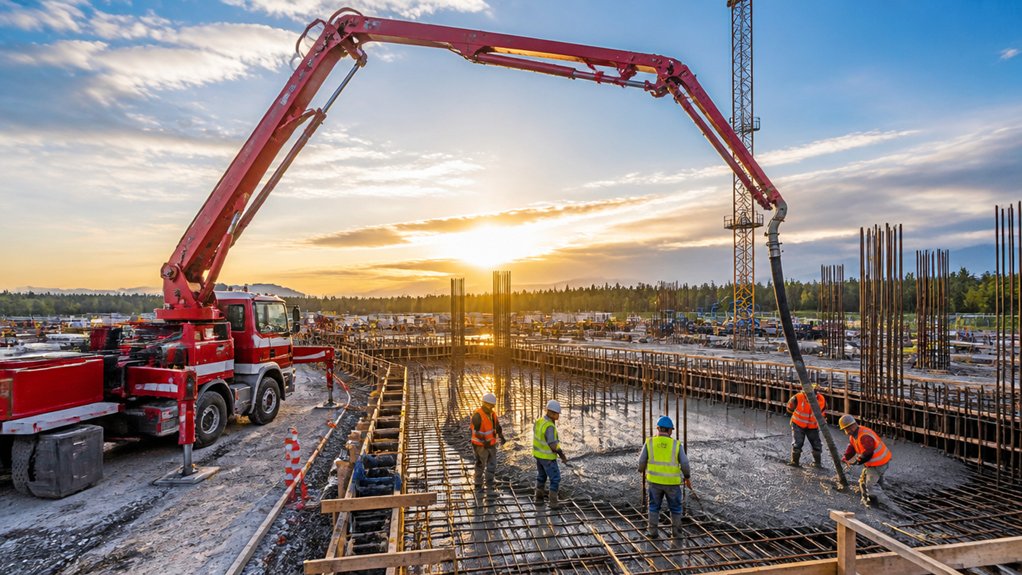
A well-coordinated concrete pump can place several times more concrete per hour than manual methods, while reducing handling and placement errors. On large pours, you can maintain a steady discharge rate, reach confined areas, and control placement more precisely than with cranes or wheelbarrows. To achieve these gains, you’ll need to match pump capacity to the pour, coordinate truck arrivals, and plan the hose layout carefully. The wrong setup, however, can quickly create costly delays.
How Concrete Pumps Speed Up Large Pours
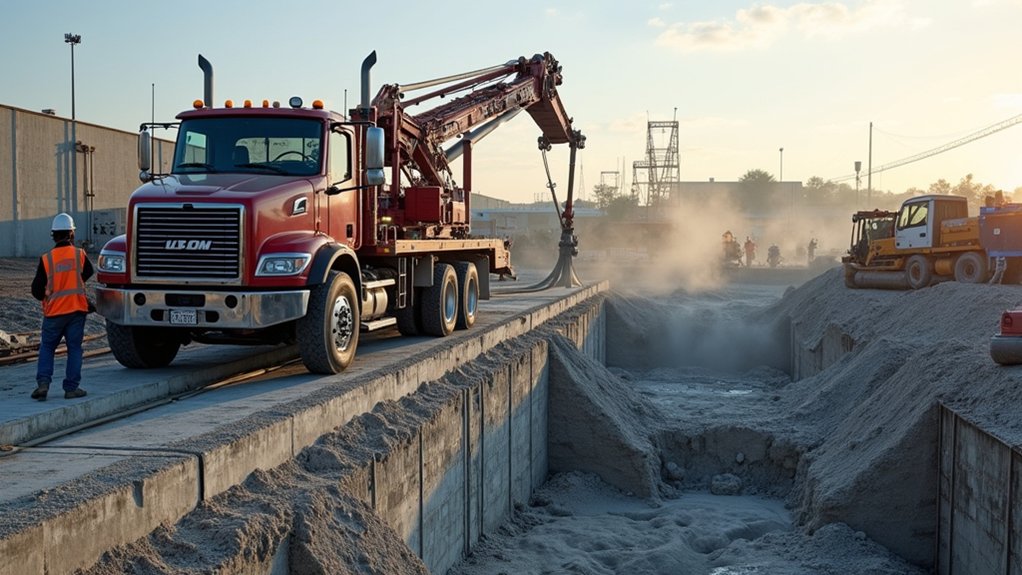
How do concrete pumps speed up large pours? You can move a continuous Concrete mix stream directly from the truck to the placement area, reducing crane lifts, wheelbarrow travel, and manual handling.
A boom or line pump keeps delivery moving across long distances and elevated locations, so your crew spends less time repositioning equipment.
Before pumping, confirm the mix has suitable slump, aggregate size, and admixture compatibility; an unsuitable Concrete mix can cause blockages and delays.
Plan truck arrivals to maintain a steady supply, and coordinate the operator, hose crew, and finishing team.
You’ll also protect production by scheduling pump maintenance, inspecting delivery lines, checking seals, and testing safety controls.
These steps reduce interruptions, preserve flow, and help you complete high-volume placements within the planned pour window.
Why Concrete Pumps Improve Placement Accuracy
Concrete pumps let you direct concrete precisely into forms, around reinforcement, and across difficult-to-reach areas.
You’ll reduce spillage and waste by controlling flow at the hose rather than relying on manual handling.
This accuracy supports consistent placement, better material use, and cleaner work areas.
Precise Material Placement
By directing concrete through a boom, hose, or placing line, a pump gives you precise control over where the material lands. You can position the discharge point close to forms, reinforcement, and embedded components, reducing uncontrolled flow and improving lift-by-lift placement.
Adjusting boom sections, hose length, and pump rate helps you follow the pour sequence while maintaining a consistent delivery pattern. Mix consistency directly affects accuracy; properly proportioned concrete moves through the system predictably and reaches congested areas without erratic surging.
You’ll also achieve better results when you coordinate the operator, nozzle person, and site crew using clear placement signals. Regular pump maintenance keeps valves, seals, and delivery lines operating reliably, so you can maintain steady pressure and precise positioning throughout the pour.
That control supports uniform consolidation and accurate form filling.
Reduced Spillage And Waste
Accurate discharge also reduces spillage and material waste around the placement area. By controlling boom movement, pump pressure, and flow rate, you can direct concrete into forms, reinforcement, and confined sections without overfilling or creating uncontrolled piles. This precision limits cleanup, reduces discarded material, and helps you maintain consistent slab thickness and structural dimensions.
It also lowers your Environmental impact by minimizing washout, truck returns, and unnecessary aggregate, cement, and water consumption. Before pumping, verify access, line stability, form readiness, and crew communication so the operator can respond immediately to changing placement conditions.
Effective supplier selection supports this process: choose a pump provider with suitable equipment, trained operators, preventive maintenance records, and reliable scheduling. When you coordinate these factors, you’ll place more usable concrete and reduce costly waste.
Choose a Concrete Pump by Reach, Volume, and Access
When selecting a concrete pump, match its reach, required output volume, and site access to the placement plan.
Choose a boom pump when you need long horizontal or vertical reach across large pours.
Select a line pump for tighter sites, restricted overhead clearance, or placements requiring flexible hose routing.
Confirm the pump’s rated output exceeds your required placing rate, while accounting for concrete slump, aggregate size, lift height, and pipeline length.
Check material compatibility between the mix, pump, hoses, and fittings to prevent blockages and premature wear.
Verify access for delivery, setup, outriggers, and cleanup before scheduling equipment.
Review pump maintenance records, inspection status, and operator qualifications to reduce interruptions.
Match the pump’s capacity to crew productivity, keeping concrete moving steadily without exceeding finishing or formwork limits during the pour.
Plan Concrete Pump Layouts for Smooth Flow
Plan the pump layout around a continuous, low-resistance pathway from the hopper to the placement point. Keep the line as straight as practical, using long-radius bends instead of sharp elbows that increase pressure and segregation risk. Support every pipe section securely, especially at joints, bends, and vertical *changeover*. Minimize elevation changes, and verify that the discharge hose can reach the entire placement zone without excessive handling.
Maintain consistent diameter through the primary line unless the pump manufacturer approves a reduction. Mix consistency matters: a uniform, workable mix flows more reliably and reduces blockages.
Before the pour, inspect couplings, gaskets, clamps, and the valve system. Regular equipment maintenance protects pressure capacity and prevents leaks. Prime the line according to project requirements, then monitor pressure during pumping to identify restrictions early.
Coordinate Crews, Trucks, and Pumps to Avoid Delays
Coordinate the placing crew, truck dispatch, and pump operator before the pour so concrete arrives continuously and the crew can place it without interruption.
Confirm the planned pour sequence, delivery intervals, pump location, hose routing, and backup access.
Assign one supervisor to manage crew communication and relay changes between the batch plant, drivers, and pump operator.
Track each truck’s loading time, travel status, and arrival position so dispatch can adjust spacing before gaps develop.
Keep the placing crew ready at the discharge point as each load approaches, and establish clear signals for starting, stopping, and repositioning the hose.
Schedule equipment maintenance before the pour, including inspections of the pump, hopper, lines, couplings, and controls.
If traffic or production changes occur, communicate immediately and revise the sequence rather than allowing idle equipment or waiting crews.
Manage Pumping Costs, Quality, and Safety
You’ll control pumping costs by matching equipment capacity, crew time, and concrete volume to the pour plan.
You’ll maintain pour quality by monitoring slump, line pressure, placement rate, and continuity.
You’ll also prioritize jobsite safety through equipment inspections, clear communication, and controlled exclusion zones.
Control Pumping Costs
How can you control pumping costs without compromising placement quality or crew safety? Start by matching pump capacity, boom reach, and crew size to the pour’s actual requirements. Accurate scheduling limits standby charges, overtime, and fuel consumption.
Plan material handling routes before delivery so trucks, pumps, and workers don’t interfere with one another. Confirm access, setup space, washout locations, and traffic controls in advance to prevent costly delays.
Track concrete volume, pumping time, fuel use, and cleanup labor on every placement. These records reveal inefficient setups and support better bids on future work.
Schedule pump maintenance according to operating hours, not only calendar dates. Inspect lines, clamps, seals, and hydraulic components before mobilization; replacing worn parts costs less than an emergency breakdown.
Train operators and crews to follow the planned sequence, reducing downtime and unnecessary equipment movement.
Maintain Pour Quality
Cost control supports quality when you maintain a consistent, uninterrupted concrete flow. Before pumping, verify Mix consistency through slump testing, aggregate distribution, and batch uniformity.
Coordinate truck arrivals with pump output so concrete doesn’t sit long enough to stiffen or develop cold joints. Keep the delivery line primed, monitor pressure, and adjust placement speed to prevent segregation, excessive bleed water, or trapped air.
Use the boom to place concrete close to its final position, reducing rehandling and unnecessary vibration. Consolidate each lift according to the mix and reinforcement density, then strike off and finish within the specified time.
Protect fresh surfaces from rapid moisture loss, temperature extremes, and premature loading. Select curing methods that match project requirements, and document placement conditions, test results, and corrective actions throughout the pour.
Prioritize Jobsite Safety
Before pumping begins, establish a jobsite safety plan that covers equipment inspection, traffic control, exclusion zones, communication, and emergency response.
You should verify the pump’s outriggers rest on stable, level support and confirm that all hose connections, clamps, and safety pins are secured.
Keep workers clear of the boom’s swing path, discharge hose, and pinch points.
Use barriers and a designated signaler to control access and coordinate movements with the operator.
Require Personal protective equipment, including hard hats, eye protection, gloves, high-visibility clothing, and safety boots.
During placement, monitor line pressure, hose movement, and ground conditions continuously.
Stop pumping immediately if you detect a blockage, instability, or communication failure.
Your Emergency response procedure should identify shutdown controls, first-aid resources, evacuation routes, and responsible contacts.
Document inspections and toolbox briefings before each pour.
Conclusion
When you’re managing a large pour, every delay can multiply labor, truck, and finishing costs. Concrete pumps help you maintain continuous placement, improve accuracy, and reach difficult forms with less waste and rework. In fact, a well-coordinated pump can place concrete several times faster than manual methods, helping you protect the pour’s schedule and quality. Plan reach, access, crew timing, and maintenance in advance, and you’ll achieve smoother flow, safer operations, and a more consistent finished structure.