

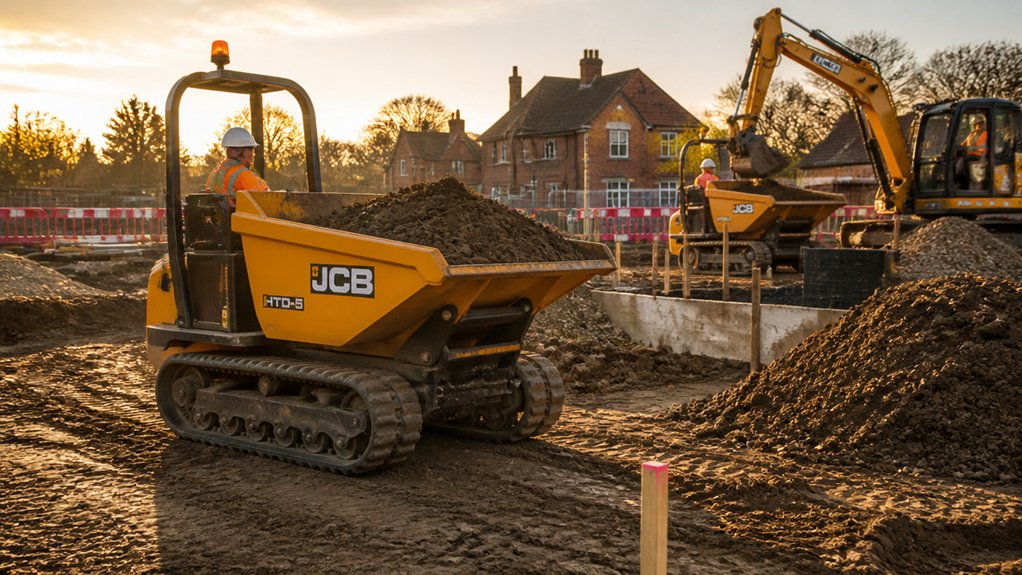
When you hire a dumper for groundworks or site clearance, you need to match its capacity, dimensions, and drive system to your site conditions. Assess ground stability, access restrictions, gradients, load volumes, and expected hire duration before choosing equipment. You should also compare delivery, operator support, safety features, and total costs. A structured selection process can prevent delays and unsafe working, but the right machine is only the starting point.
Choose the Right Dumper Hire for Your Site

Choosing the right dumper hire starts with matching the machine to your site’s access, ground conditions, load requirements, and project scale. Assess the working environment before contacting a hire company. Identify slopes, soft ground, confined areas, overhead obstructions, pedestrian routes, and exclusion zones.
Confirm whether you need tracked or wheeled equipment, swivel skip capability, four-wheel drive, or low-ground-pressure performance. Review the machine’s operating controls, visibility, braking system, guarding, and inspection records.
Ask the supplier about delivery, collection, fuel, breakdown response, and replacement arrangements. Check that documentation covers current certification, insurance, and thorough examination requirements.
Plan dumper training for every operator, including familiarisation with the hired model. Schedule Dumper maintenance checks throughout the hire, recording defects and removing unsafe equipment from service immediately.
Match Dumper Capacity to Access and Loads
Match dumper capacity to both the available access and the material load, because an oversized machine may be unable to manoeuvre safely while an undersized model can increase cycle times and overloading risks. Measure gate widths, track gradients, turning areas and ground bearing conditions before selecting a machine.
Check the payload against your typical materials, including soil, aggregate and wet spoil; never exceed the manufacturer’s rated capacity.
Articulated dumpers suit uneven, restricted routes, while compact site dumpers work well where access is tighter. Consider tipping height and discharge clearance, particularly beside trenches or into skips.
Confirm that the operator can maintain visibility around stockpiles, edges and pedestrians. Effective operator training reduces unsafe loading and manoeuvring.
Schedule dumper maintenance inspections to preserve braking, steering, tyres and stability throughout the project.
Compare Dumper Hire Costs, Delivery and Support
When comparing dumper hire costs, assess the complete operating cost rather than the advertised daily rate. Request an itemised quotation covering the hire period, delivery, collection, fuel, insurance, damage waiver, and VAT.
A thorough cost comparison should also include standby charges if your programme changes. Confirm the dumper’s payload, dimensions, tipping mechanism, and ground conditions suitability, because an unsuitable machine can increase handling and replacement costs.
Check delivery times, unloading requirements, and whether the supplier can collect from site without delay. Ask what support you’ll receive, including emergency call-outs, replacement equipment, and telephone advice.
Clarify who handles routine Equipment maintenance, inspections, and repairs, and how quickly faults are resolved. Choose a supplier offering transparent pricing, dependable logistics, and documented support, not simply the lowest headline rate.
Plan Safe, Efficient Dumper Operation
Plan dumper operations around the site layout, ground conditions, traffic routes, and the sequence of loading and tipping. Establish one-way systems where possible, separate pedestrians from plant, and mark reversing zones clearly. Check gradients, edge protection, overhead hazards, and ground bearing capacity before work starts.
Choose a dumper with suitable payload, stability, and terrain capability; never exceed its rated capacity. Require operator training covering controls, load security, visibility, rollover risks, and emergency procedures.
Apply site-specific safety protocols, including daily inspections, seat-belt use, speed limits, and reliable communication between drivers and banksmen. Load evenly, keep the skip low while travelling, and tip only on firm, level ground.
Stop operations during unsafe weather or when visibility deteriorates. Review routes regularly as excavation and stockpiles change.
Conclusion
Choosing the right dumper hire can improve productivity, control costs, and keep groundworks or clearance projects compliant. Don’t judge machines by capacity alone: match payload, turning space, terrain, and delivery access to your site plan. With construction transport accounting for roughly 25% of global transport emissions, efficient loading and fewer journeys matter. Confirm support, train operators, inspect equipment, and define routes before work begins. That preparation will help you move material safely, quickly, and economically.