

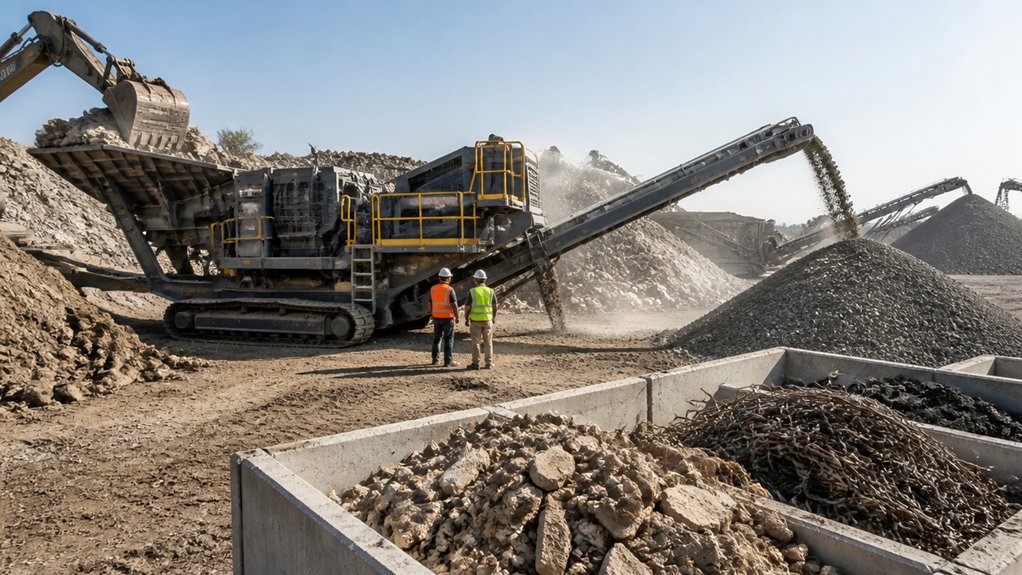
You can turn demolition waste into a useful resource instead of sending it to a landfill. Aggregate crushers process concrete, asphalt, and other materials into consistent recycled aggregates for new construction. On-site crushing also reduces hauling distances, fuel use, and emissions while supporting material reuse. To make this approach work, you’ll need to understand processing options, quality verification, and equipment selection—because the crusher you choose can determine both project performance and environmental gains.
How Do Crushers Reuse Construction Waste?
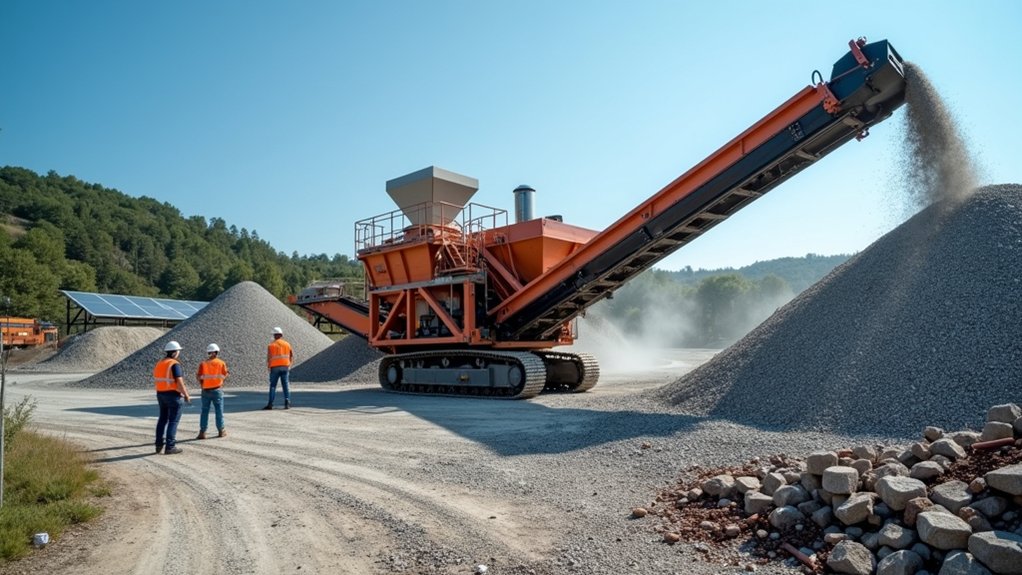
Aggregate crushers reuse construction waste by reducing concrete, asphalt, masonry, and other inert materials into graded particles for new construction applications. You can feed sorted demolition debris into a crusher, where impact, compression, or jaw action breaks oversized pieces into usable sizes.
Screening and recirculation then produce consistent aggregate, while magnets and air separators remove reinforcing steel and light contaminants. With innovative crushing techniques, you can adjust settings, monitor output, and improve particle shape for base courses, fill, drainage layers, and recycled concrete production.
This process supports environmental impact mitigation by diverting waste from landfills, reducing demand for quarried stone, and lowering transport-related emissions. You’ll also conserve energy and resources when you process debris near the construction site, provided you control dust, noise, runoff, and equipment emissions.
What Can Aggregate Crushers Process?
When properly sorted, aggregate crushers can process concrete, asphalt, brick, masonry, natural rock, and other clean, inert materials into controlled sizes for construction use. You can feed jaw crushers large, rigid pieces for primary reduction, then use impact or cone crushers to refine the product.
Screens separate fine particles from larger aggregate, while magnets remove reinforcing steel and other ferrous metal. You should exclude soil, asbestos, treated wood, plastics, chemicals, and other contaminants unless specialized equipment and permits address them.
Match the crusher to your feed size, hardness, moisture, and target gradation. Material durability affects wear rates and product quality, so inspect liners, belts, bearings, and screens routinely.
Consistent Crusher maintenance supports safe operation, reliable sizing, and efficient processing of suitable materials.
How Recycled Aggregates Cut Waste and Emissions
By processing suitable demolition materials into usable stone, recycled aggregates keep concrete, asphalt, and masonry out of landfills while reducing demand for virgin quarrying.
When you use an aggregate crusher near your project, you can shorten hauling distances, lower fuel consumption, and reduce traffic-related emissions.
Reusing recovered material also limits blasting, excavation, and processing at new quarries, reducing your operation’s Environmental impact.
You’ll often improve Cost efficiency because on-site or regional processing reduces tipping fees, purchased aggregate, and transportation costs.
Crushed concrete and asphalt can support road bases, drainage layers, and other applications, conserving finite resources.
You should plan material recovery early, separate debris streams, and coordinate crusher capacity with project demand.
These steps help you turn demolition waste into a practical construction input while cutting emissions.
How Do You Verify Recycled Aggregate Quality?
Recycled aggregate delivers environmental benefits only when it meets the performance requirements of its intended use. You should verify quality through documented sampling, laboratory testing, and production controls.
Begin by identifying contaminants such as wood, plastic, gypsum, glass, and asphalt, then measure particle-size distribution, moisture content, density, absorption, and crushing resistance.
Quality testing should also assess chemical properties, including chlorides, sulfates, and potential alkali-silica reactivity, when concrete applications require it.
Compare every result with applicable Material standards, project specifications, and local regulations.
You’ll need consistent records linking test results to stockpiles and processing batches.
Visual inspections support, but never replace, laboratory evidence.
Confirm that the aggregate’s grading and durability suit its intended application, and establish routine retesting to detect variation before it affects construction performance or compromises responsible material reuse.
How Do You Choose an Aggregate Crusher?
How do you choose an aggregate crusher that balances capacity, product quality, operating cost, and environmental performance? Start by matching the crusher type to your feed material, required output, hardness, moisture, and desired particle shape.
Jaw crushers suit primary reduction, while impact and cone crushers refine gradation for specific applications. Check throughput, energy consumption, dust controls, noise limits, and compatibility with recycled concrete or reclaimed asphalt.
Consider automation, wear-part availability, and site access before committing. Reliable crusher maintenance reduces unplanned downtime, extends equipment life, and limits material waste.
Evaluate total lifecycle cost rather than purchase price alone, including fuel, replacement parts, labor, and emissions. Choose equipment with adjustable settings and efficient screening so you can optimize operational efficiency, produce consistent aggregate, and support sustainable construction goals.
Conclusion
Aggregate crushers help you turn demolition waste into dependable resources instead of landfill burdens. By processing concrete, asphalt, and other materials on-site, you’ll reduce virgin aggregate demand, hauling emissions, and project costs. Verify gradation, cleanliness, and strength so your recycled product meets specifications and performs reliably. When you choose equipment suited to your feedstock and output goals, you’re closing the material loop—turning yesterday’s structures into tomorrow’s foundations. That’s practical progress with measurable environmental value.