

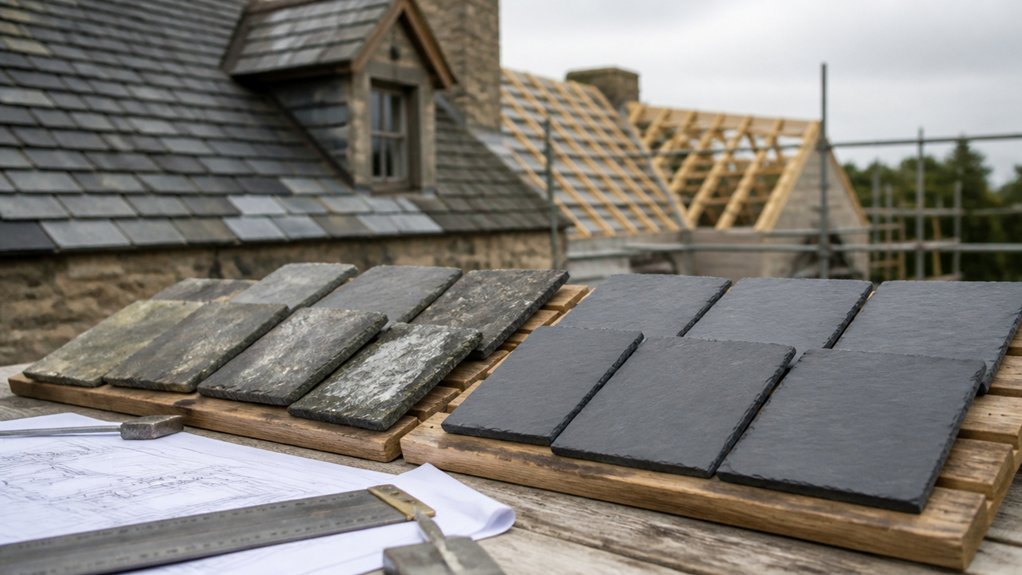
When you select roofing slate for renovation or new-build work, assess more than appearance. Check the roof pitch, exposure, loading capacity, detailing and local regulations before comparing natural slate with fibre cement alternatives. Confirm the required colour, finish, thickness, size and fixing method, then verify product standards, test data and source documentation. A suitable slate must perform reliably and complement the building, but one overlooked specification can affect compliance, cost and installation.
Check Your Roof’s Pitch, Style and Requirements
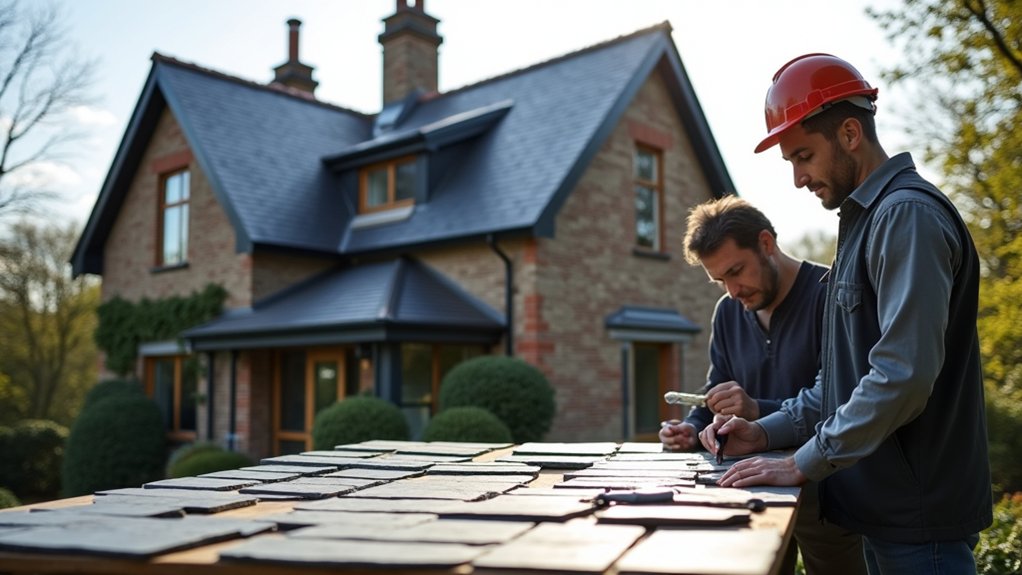
Before choosing roofing slate, check your roof’s pitch, design, and structural requirements to confirm that the material is suitable.
Start with roof slope considerations: verify the proposed slate’s minimum pitch, required lap, gauge, and fixing method against the manufacturer’s specifications and applicable building regulations. A shallow roof may need a different detailing strategy, underlay, or weathering assessment before installation proceeds.
Confirm that the existing or proposed structure can support the finished roof, battens, fixings, snow loads, and wind uplift. Ask a qualified designer or building-control professional to verify calculations where required.
Next, assess building style compatibility. Match the slate’s format, colour range, texture, and coursing to the property’s architectural character and any conservation-area controls.
Check planning conditions, listed-building consent, ventilation requirements, fire performance, and junction details before ordering or commencing work.
Compare Natural and Fibre Cement Roofing Slate
When comparing natural slate with fibre cement slate, assess service life, weight, performance, installation requirements, and compliance rather than appearance alone.
Natural slate can offer exceptional longevity, fire resistance, and low replacement frequency. However, you’ll need to verify thickness, strength, origin, and suitability for the roof structure.
Fibre cement slate usually weighs less, provides consistent dimensions, and can simplify handling, cutting, and installation. However, you must confirm its declared performance, water absorption, wind resistance, fire classification, and compatibility with the manufacturer’s fixing system.
Check current Building Regulations, relevant British or European Standards, and any project-specific warranty conditions before selecting either product.
Consider whole-life impacts: responsibly sourced natural slate and durable fibre cement products may provide Eco friendly alternatives.
Include Maintenance considerations, access, breakage, fastener corrosion, and eventual disposal in your cost assessment.
Choose a Roofing Slate Colour and Finish
Match the slate colour to your building’s setting, considering local character, planning requirements, and conservation controls.
Compare finishes such as natural riven, smooth, and textured surfaces for appearance, weathering, and slip resistance.
Confirm that your selected product meets the project specification and applicable roofing regulations.
Match Colour to Setting
Choose a slate colour and finish that suits the building’s setting, roof pitch, and planning requirements. Assess neighbouring roofs, local stone, brickwork, render, and landscape before you specify a shade.
In a conservation area or designated heritage setting, you’ll need to check local planning guidance and obtain approval where required; some authorities expect traditional grey, blue-grey, or weathered tones.
For new builds, confirm that your proposed colour meets the planning consent, design code, and any developer or estate conditions.
Consider roof pitch carefully: darker slates can emphasise large roof planes, while lighter tones may reduce visual mass.
Use samples outdoors, because daylight and surrounding materials alter perceived colour.
Good Color coordination creates aesthetic harmony, helping your renovation or new roof complement its context without compromising compliance or durability.
Compare Slate Finishes
Once the colour suits the setting, compare slate finishes for their effect on appearance, weathering, and installation.
Choose a natural riven surface when you want texture, subtle shadowing, and a traditional character. Select a sawn or honed finish for cleaner lines, but confirm that its smoothness won’t reduce installer grip or increase slipping during handling.
Textural diversity can affect water run-off, lichen retention, and visual consistency, so request representative samples and inspect them in changing light.
Check the manufacturer’s data for thickness tolerances, nail-hole suitability, frost resistance, and fixing requirements.
Your selected product must comply with applicable standards, planning conditions, and the roof design’s wind, pitch, and exposure calculations.
Also assess Environmental impact: prioritise documented quarry practices, recycled content, service life, and responsible transport.
Ensure your contractor follows the installation guidance.
Check Roofing Slate Size, Thickness and Fixings
Check the slate’s size and thickness against the roof pitch, rafter spacing, exposure, and local loading requirements before ordering, because these factors determine whether it provides adequate weather protection and structural performance.
Confirm the manufacturer’s recommended coverage, gauge, headlap, and side lap for your location and roof geometry.
Select dimensions that suit the battens or boarding, allowing accurate alignment without excessive cutting.
Follow the relevant building regulations and roofing standard, and obtain a fixing schedule for the specified slate.
Use corrosion-resistant nails or approved hooks compatible with the slate and exposure category.
Your installation techniques must maintain prescribed laps, nail positions, and edge distances.
Account for wind uplift and snow loads, particularly at verges, eaves, ridges, and valleys.
Correct sizing supports Slate durability and reduces failure risk.
Verify Roofing Slate Quality, Standards and Source
You’ll need to confirm that the slate meets applicable national standards and project specifications.
Verify the quarry source and traceability documents, then assess quality certifications from recognized testing or certification bodies.
Check Slate Standards
Before approving any roofing slate, verify that it meets the applicable national or regional standard for natural roofing slate, including requirements for durability, water absorption, dimensional tolerance, frost resistance, and breaking strength.
Check the product declaration, test reports, and conformity markings against the project specification and building regulations.
Confirm that the proposed thickness, format, surface finish, and fixing method suit the roof pitch, exposure, and design life.
For Historical restoration, compare the slate’s performance and appearance with conservation requirements, but don’t accept visual similarity without documented compliance.
Evaluate Eco friendly options through verified environmental information, such as recycled content, service life, and responsible production claims.
Require current certificates from an accredited testing body, and record each acceptance decision in the project quality file before installation begins.
Where standards conflict, apply the stricter requirement.
Verify Quarry Source
Once the slate meets the required standards, verify its quarry source and chain of custody. Ask your supplier to identify the quarry, extraction site, processor, and distribution route for each batch. Check delivery records, invoices, and product references so you can trace material back to its origin. This documentation supports sourcing transparency and helps you detect substitutions, mixed batches, or unauthorised imports.
Confirm that the quarry operates lawfully under applicable planning, environmental, labour, and extraction requirements. Review evidence of quarry sustainability, including land-management measures, waste control, water protection, and site restoration commitments.
For renovation work, compare the proposed slate’s geological origin and appearance with the existing roof where matching matters. Record the source, batch details, and supplier declarations in your project file, enabling effective procurement checks and future maintenance decisions.
Assess Quality Certifications
Check the slate’s quality certifications against the standards specified for the project and the jurisdiction where it will be installed. Confirm that the supplier provides current test reports, declarations of performance, and traceable batch documentation.
Review applicable Certification standards for water absorption, freeze-thaw resistance, flexural strength, dimensional tolerances, and fire performance. These results should correspond to the slate grade and intended exposure, not merely to a product family.
Verify that an accredited, independent laboratory performed the testing and that certificates identify the quarry, processing facility, production date, and standard edition.
Compare markings and paperwork with the delivered pallets before installation.
Assess Material durability by checking accelerated-weathering data, service-life guidance, and warranty exclusions. If documentation is incomplete, inconsistent, or expired, request clarification or select another product.
Retain certificates for building-control inspections, future repairs, and warranty claims.
Plan Roofing Slate Costs and Installation
Plan the slate roof budget around material grade, delivery, waste, removal, underlayment, flashing, labor, access, and required permits.
Begin cost estimation by measuring roof areas, pitches, penetrations, and verge details, then add a realistic allowance for breakage and cutting.
Confirm whether the existing structure can carry slate; you may need an engineer’s assessment and reinforcement before ordering materials.
Specify compatible battens, nails, membranes, and lead or approved alternative flashings, matching local building regulations and conservation requirements.
Require your contractor to document installation techniques, including course setting, headlap, fixing patterns, valley construction, and ventilation.
Obtain itemized quotations that separate materials, labor, scaffolding, waste disposal, and taxes.
Schedule inspections at required stages, and verify warranties, product certification, and the installer’s slate experience before work begins.
Conclusion
Selecting the right roofing slate means balancing performance, appearance, compliance, and cost. You’ll need to match the slate to your roof’s pitch, exposure, structure, and architectural character, then confirm its size, thickness, fixings, and installation method. Compare natural and fibre cement options carefully, checking certification, source documentation, and environmental considerations. Don’t let price become false economy: a compliant, correctly installed slate roof protects your building—and your investment—for decades.