

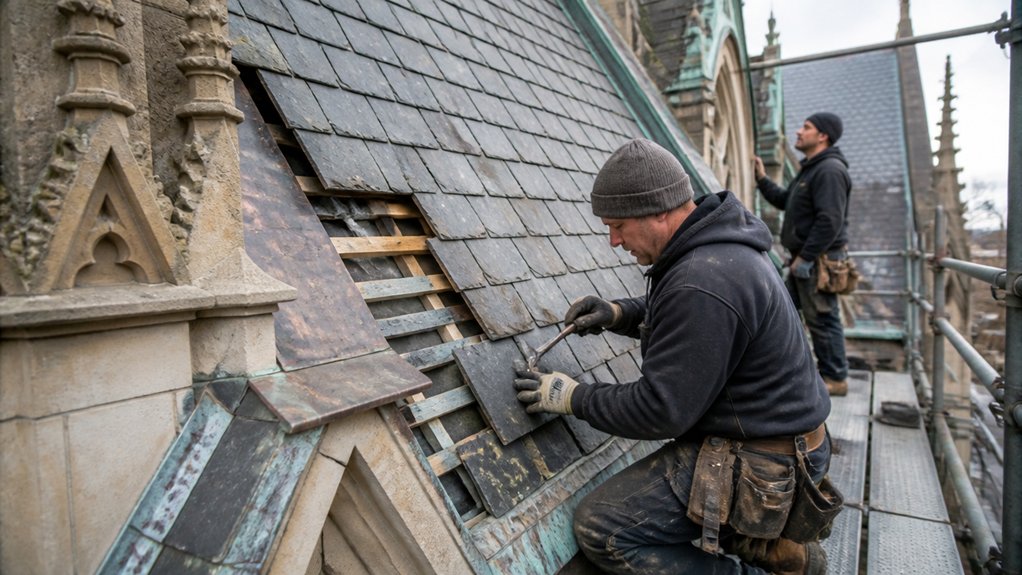
When you repair or replace a slate roof on a heritage property, you must balance weatherproofing with conservation requirements. Start by inspecting the roof, recording damage, and checking local heritage rules before disturbing any materials. Then decide whether careful repairs can preserve most of the existing slates or whether limited replacement is justified. Matching slate, traditional fixings, and documented workmanship all matter, but one hidden condition can change the entire repair strategy.
Check Slate Roof Damage and Heritage Rules
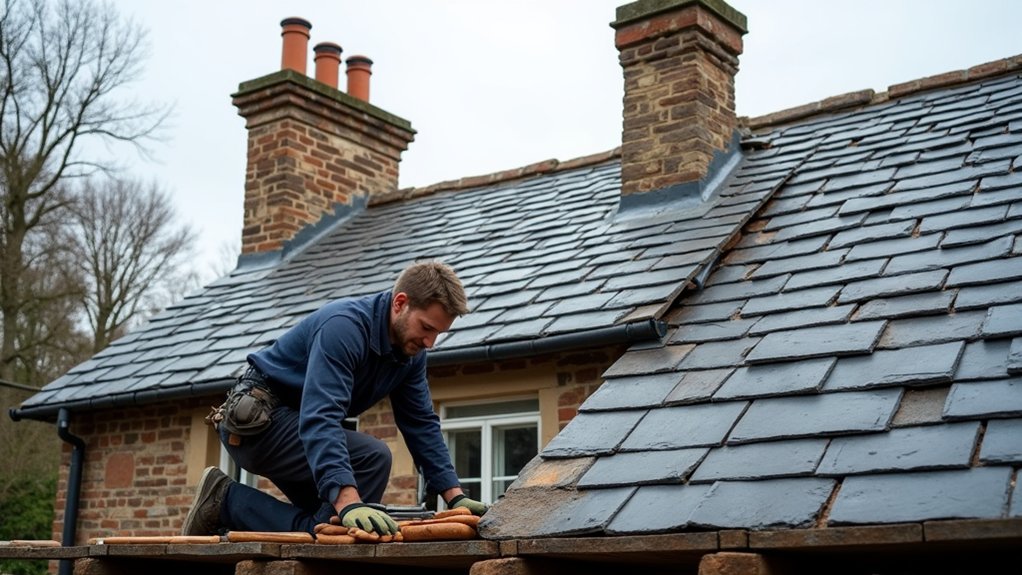
Before planning any repair, inspect the slate roof systematically for cracked, slipped, missing, or delaminated slates, failed fixings, damaged flashings, and signs of water ingress in the roof space.
Record each defect on a scaled roof plan, photograph surrounding details, and note slate sizes, coursing, fixing methods, and previous interventions.
Check the loft for damp staining, timber decay, and daylight, but don’t disturb fragile fabric unnecessarily.
Then research the property’s Historical significance, construction date, alterations, and conservation status.
Consult listed-building records, local planning guidance, and relevant statutory authorities to identify consent requirements.
Determine whether the roof contains original slates, later replacements, or distinctive regional details.
Preserve evidence through careful documentation, and prioritise Material conservation when evaluating defects and selecting appropriate investigative methods.
Avoid assumptions based solely on surface appearance.
Decide Between Slate Roof Repair and Replacement
Choose repair when defects remain localised and the existing slates, fixings, battens, underlay, and roof structure retain adequate serviceability. Record slipped, cracked, or punctured slates, then trace moisture paths and inspect concealed components before deciding. Targeted renewal usually preserves more historic fabric, reduces disturbance, and limits waste.
Choose replacement when widespread failure, repeated leakage, extensive fixing corrosion, defective substrate, or structural movement makes isolated work unreliable. If the roof has lost overall serviceability, document its condition and obtain conservation advice before authorising wholesale removal. Don’t let appearance alone determine the scope.
Your Cost analysis should compare immediate repairs with lifecycle costs, access, temporary protection, surveying, and future maintenance. During contractor selection, verify heritage experience, references, insurance, and method statements. Require a written schedule defining salvage, recording, sequencing, and quality checks. Guarantee the proposal meets consent conditions and building regulations.
Choose Matching Slate and Traditional Materials
Match replacement slate to the original in geology, colour, thickness, texture, size, and dressing, using surviving roof slates and historic records as evidence. Record each characteristic before ordering materials, and compare samples in natural light against clean, weathered slates.
Effective Color matching considers ageing, patination, iron staining, and tonal variation rather than a single uniform shade.
Confirm dimensions, hole placement, edge treatment, and thickness so replacement pieces sit visually and structurally within the existing roof.
For Material sourcing, consult specialist merchants, regional quarries, reclamation yards, and conservation advisers who can document provenance and provide consistent batches.
Reject imported alternatives that imitate appearance but differ in mineral composition or durability.
Obtain enough matching slate for repairs, plus carefully selected reserves, and retain samples and supplier records for future conservation work.
Guarantee flashings, battens, and fixings also suit the building’s heritage character.
Use Traditional Methods for Heritage Slate Repairs
Use established slate-roofing techniques that preserve the building’s original construction and allow future repairs. Begin by removing slates carefully, lifting copper or stainless-steel fixings without widening sound holes. Retain reusable units in their original courses, and record each location before replacement.
Cut new slates to matching dimensions, thickness, texture, and edge profile; use Slate carving only where documented details require it. Fix slates with traditional nails or hooks compatible with the existing work, avoiding rigid modern adhesives and excessive mechanical alteration.
Dress valleys, verges, ridges, and abutments with historically appropriate methods and metals, maintaining proper laps and ventilation paths. Match mortar composition to surviving fabric, and keep joints neat but breathable.
Your workmanship should support historical preservation while remaining reversible, legible, and technically sound. Follow conservation specifications and consult a specialist when evidence is incomplete.
Plan and Maintain a Heritage Slate Roof Replacement
Before removing sound slates, develop a phased replacement plan based on a condition survey, historic evidence, and the roof’s drainage and structural requirements. Record slate sizes, coursing, fixing patterns, underlay, flashings, and areas of failure.
Prioritize active leaks and unsafe sections, while protecting sound historic fabric. Plan color matching by comparing replacement slates in natural light, not under artificial lighting.
Confirm material sourcing early; reclaimed slates may match age and texture, while new equivalents must meet appropriate thickness, strength, and water-absorption standards. Retain representative sound slates for future repairs, and label removed materials for possible reuse.
Require your roofer to photograph concealed details before closing each phase. After completion, inspect annually and after severe weather, clear gutters and valleys, monitor fixings and flashings, and document every intervention for future maintenance.
Conclusion
Repairing a heritage slate roof isn’t an invitation to “improve” history with shiny substitutes and heroic shortcuts. You’ll inspect damage, check permissions, repair locally where possible, and replace only what’s beyond saving. Match slate, fixings, and workmanship with disciplined care; document concealed details before they vanish beneath the courses. Then maintain the roof routinely, because even the finest conservation plan won’t defeat neglect. Your reward? A watertight roof that preserves its past without becoming a museum exhibit.