

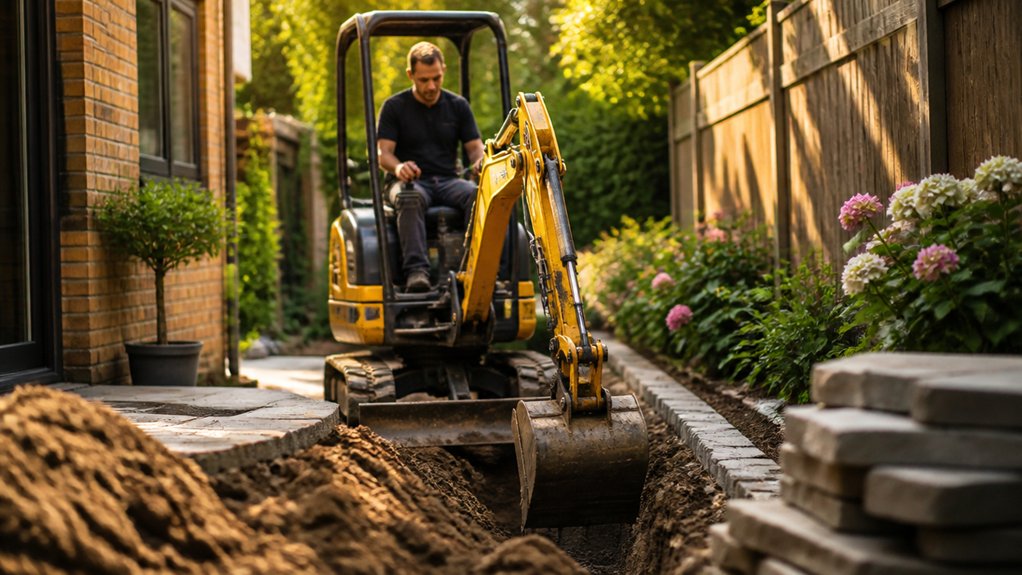
If you’re planning domestic renovation or landscaping work, a mini digger can give you the reach, control, and access that larger machinery can’t. Its compact dimensions help you work in gardens, narrow driveways, and around existing structures, while rubber tracks reduce damage to lawns and paving. With the right attachment, you can excavate, trench, grade, or plant efficiently—but choosing the correct machine depends on your site, ground conditions, and project requirements.
Are Mini Diggers Right for Home Projects?
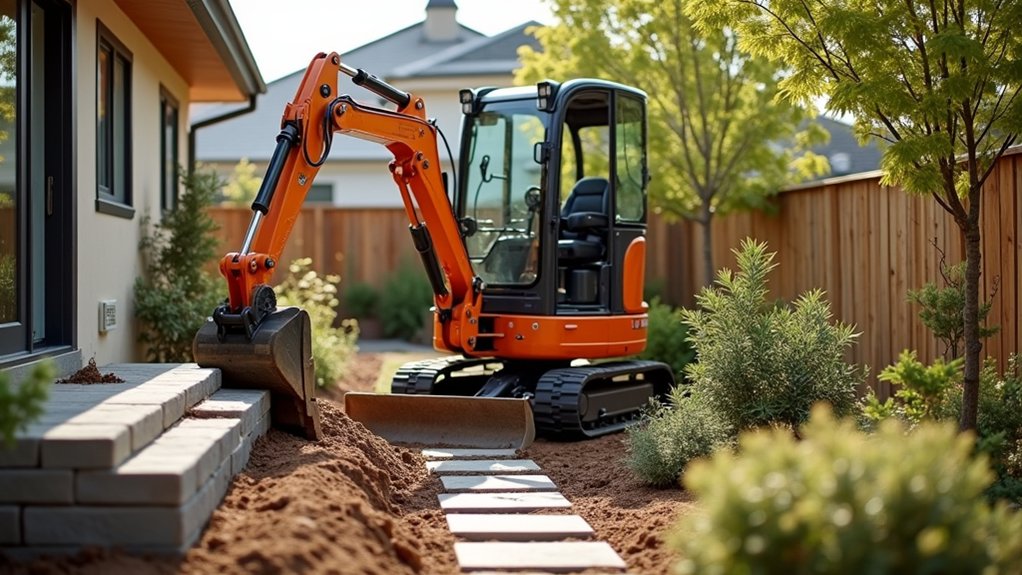
Mini diggers suit many domestic renovation projects because their compact dimensions, low ground pressure, and precise hydraulic controls let you excavate in confined spaces with less disruption than larger machinery. You’ll find them suitable when access is limited, ground conditions are sensitive, or excavation must remain controlled near existing structures.
Their reduced width can pass through gates, while rubber tracks help protect paving and finished surfaces. For garden design, you can grade soil, form planting areas, and prepare drainage routes with accurate bucket movements.
They’re also effective for building foundations when you need consistent trench depth and careful clearance around services. Check the machine’s operating weight, reach, lift capacity, and attachment options before hiring.
You’ll still need competent operation, utility checks, and appropriate permits where local regulations require them.
What Can You Use a Mini Digger For?
You can use a mini digger for trenching, foundation preparation, drainage installation, landscaping, and removing soil or light demolition waste. You’ll find it useful for creating service runs for water, electricity, and telecommunications, while its compact dimensions help you work beside walls, gates, and established planting.
Use it to excavate footings, level uneven ground, clear roots, and shape beds or paths with controlled accuracy. Before digging, confirm underground utility locations, establish exclusion zones, and assess ground stability.
Good site safety also means wearing suitable PPE, keeping bystanders clear, and operating on stable surfaces. Inspect hydraulic lines, tracks, controls, and fluids before each shift; regular equipment maintenance reduces downtime and prevents faults.
Plan spoil storage carefully, protect finished surfaces, and stop work if visibility, weather, or ground conditions become unsafe.
Which Mini Digger and Attachments Do You Need?
Choose a mini digger by matching its operating weight, width, maximum digging depth, and lift capacity to the site and task. For narrow access, select a compact zero-tail-swing model; choose greater power and reach for foundations, drainage, or heavy soil.
Match attachments precisely: use a narrow bucket for trenching, a wider bucket for grading, and a grading beam for levelling. A hydraulic breaker suits concrete and masonry, while an auger drills post holes efficiently.
Consider quick-hitch compatibility, auxiliary hydraulic flow, and attachment weight before hiring. Check ground pressure when working near paving, lawns, or buried services.
For Mini digger safety, confirm guards, emergency controls, visibility, and operator training. Follow the manufacturer’s Mini digger maintenance schedule, including daily checks of tracks, pins, hoses, fluids, and bucket teeth.
Guarantee every attachment locks securely before operation.
How Do Mini Diggers Save Time and Labour?
When excavation, trenching, or material handling is planned efficiently, a mini digger completes repetitive work faster and with less physical labour than hand tools. You can dig consistent trenches, remove spoil, level ground, and transport materials using one compact machine, reducing crew size and project duration.
Hydraulic controls provide precise movement, while interchangeable buckets, augers, breakers, and grading blades let you change tasks quickly without hiring separate equipment.
Its compact dimensions also allow access through gates and around buildings, limiting manual handling in confined areas.
Apply safety considerations by checking underground services, maintaining stable ground, and keeping bystanders clear.
Follow maintenance tips, including daily fluid checks, track inspection, and greasing pivot points, to prevent downtime.
Proper planning and operator training maximise productivity while protecting your property and equipment.
Conclusion
Whether you’re renovating, landscaping, or repairing drainage, a mini digger gives you controlled capability in compact spaces. You’ll complete demanding digging, grading, and trenching tasks faster, with less manual labour and minimal disruption to lawns or paving. Choose the correct machine and attachment for each application, then operate it responsibly and safely. With precise hydraulics, practical power, and versatile performance, mini diggers make domestic projects simpler, safer, and considerably more efficient.